The Art of Black and White: Valentine's Day Patterns for Modern Design
When we imagine Valentine's Day visuals, our minds often leap to crimson hearts, pink florals, and candy-box frills. Yet there exists a quieter, more sophisticated visual language that speaks just as powerfully to the theme of affection: the monochromatic palette of black and white. Patterns Valentine's Day Black and White offer designers, crafters, and business owners a refined alternative that works across contexts where color might clash or overwhelm. A set of seamless patterns built around this classic duo provides repeatable, scalable artwork that can be deployed anywhere from a wedding invitation to a product label, a digital planner page to a shop window display.
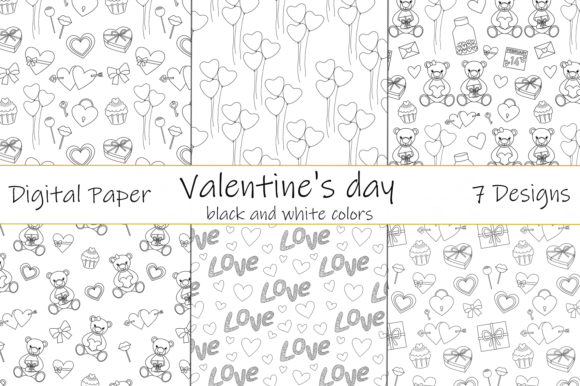
This article explores a specific collection of seven seamless patterns in black and white, delivered in multiple file formats, and examines how such a set can serve a broad range of creative and commercial projects. Rather than focusing on the product itself in a promotional sense, we will look at the practical and aesthetic considerations that make monochromatic Valentine's patterns a valuable addition to any design toolkit. The discussion will cover file types, software workflows, real-world applications, and the unique advantages of working within a black-and-white constraint.
The Timeless Appeal of Monochromatic Valentine's Design
Black and white design carries a visual authority that color often cannot match. Without hue to distract, the eye focuses entirely on line, form, contrast, and texture. In the context of Valentine's Day, this translates into patterns that feel both romantic and restrained, intimate and modern. A heart motif rendered in black linework against a white background can read as elegant, while a dense arrangement of arrows, lace, and botanical forms in negative space offers complexity without chromatic noise.
Why Black and White Transcends Seasonal Trends
One of the strongest arguments for investing in Patterns Valentine's Day Black and White is longevity. Seasonal color trends shift from year to year. One season may favor blush pink and copper; the next may lean toward deep burgundy and gold. A black-and-white pattern remains compatible with any accent color you choose to pair with it. That same pattern can appear on a Valentine's card this February and on a wedding invitation next June, simply by changing the surrounding palette. For businesses and creators who want to maximize the shelf life of their design assets, monochromatic patterns offer exceptional return on investment.
Furthermore, black-and-white patterns lend themselves to printing on a wide variety of substrates. They can be heat-pressed onto fabric, embossed on cardstock, or screen-printed onto packaging without the production challenges that come with full-color gradients. The absence of color also reduces ink costs and simplifies prepress workflows.
Exploring the Seamless Pattern Collection
A seamless pattern does not show visible edges when tiled, making it ideal for backgrounds, wrapping paper, fabric, and any surface where repetition is needed. The collection under discussion includes seven distinct seamless pattern designs, each developed to work as a standalone surface or as part of a layered composition. Every design reflects Valentine's iconography hearts, arrows, floral motifs, filigree, and abstract romantic geometry but interpreted through the stark clarity of black and white.
Vector EPS Files for Professional Workflows
The inclusion of seven vector EPS files is critical for users who need resolution-independent artwork. Vector files store patterns as mathematical paths rather than pixel grids, which means they can be scaled to any size without losing sharpness. A heart pattern designed at postage-stamp dimensions can be enlarged to a billboard without degradation. EPS is a widely supported format that opens in most professional design applications, including Adobe Illustrator, CorelDRAW, and Affinity Designer. Users can edit individual elements, recolor shapes, or combine motifs from different patterns to create custom compositions. For anyone producing large-format prints, signage, or textile runs, vector files are non-negotiable.
SVG Files for Web and Digital Projects
SVG (Scalable Vector Graphics) files serve a parallel purpose for digital environments. While EPS handles print and traditional vector workflows, SVG is the standard for web-based graphics, interactive documents, and responsive design. The seven SVG files in the collection allow users to embed the same seamless patterns directly into websites, digital planners, e-books, and mobile applications. Because SVG is written as XML, it can be styled with CSS, animated with JavaScript, and manipulated dynamically. A digital scrapbooker working in an app like Procreate or Canva may find SVG easier to import than EPS, and a web designer can use SVG patterns as repeatable backgrounds with minimal code overhead. The availability of both vector formats ensures that the patterns function equally well on screen and on paper.
JPEG Files for Quick Implementation
Not every project requires vector flexibility. Sometimes a designer needs a ready-to-use raster image that can be dropped into a document or presentation immediately. The seven JPEG files in the collection answer that need. Each JPEG contains a high-resolution render of the seamless pattern, suitable for digital mockups, social media graphics, and rapid prototyping. JPEG files are universally readable, require no special software to open, and can be printed at moderate sizes with good results. For educators creating classroom materials, hobbyists working in low-cost design tools, or business owners who need quick turnaround on a promotional card, JPEG files eliminate the learning curve associated with vector editors. They also serve as preview files: a user can open a JPEG to evaluate a pattern's appearance before committing to a full vector workflow.
Practical Applications Across Creative Projects
The true value of a pattern set lies in its versatility. Below are several categories of use where Patterns Valentine's Day Black and White can be applied effectively, along with observations on how each context benefits from the monochromatic approach.
Digital Scrapbooking and Planner Design
Digital scrapbooking has grown into a substantial creative practice, with enthusiasts building layered pages that document memories, travel, holidays, and daily life. Valentine's Day themes are popular in February layouts, but the bold pinks and reds of conventional Valentine's graphics can compete with photographs and journaling. Black-and-white patterns solve this problem by adding visual interest without overwhelming the page. A subtle filigree heart pattern used as a page background keeps the focus on the photos while still signaling the romantic theme. Planner designers can use the same patterns for monthly divider pages, weekly spreads, or sticker sheets. Because the patterns are seamless, they tile perfectly across digital canvases without awkward breaks.
Digital planners in particular benefit from SVG files, which remain crisp on Retina displays and can be resized to fit any planner format from A5 to letter. Users of apps like GoodNotes, Notability, and Keynote can import the patterns as image layers and adjust opacity to create ghosted backgrounds or decorative headers.
Packaging and Greeting Cards
Packaging designers face tight constraints around color, cost, and printability. A black-and-white pattern reduces the number of ink plates needed, which lowers production costs and simplifies quality control. For a small business producing Valentine's-themed gift boxes, tags, or tissue paper, the seven patterns in this collection offer immediate options. A pattern of overlapping hearts can wrap a chocolate box; a geometric arrow motif can adorn a gift bag. Greeting card designers can use the patterns for card fronts, inside liners, or envelope liners. The high-contrast nature of black and white ensures that text overlaid on the pattern remains readable, especially when the pattern is placed behind a white text box or used as a border.
One practical observation: when printing black-and-white patterns on kraft or colored paper, the black ink reads strongly while the white areas become the paper color. This effect can be used intentionally to coordinate with brand colors. Using the EPS files, a designer can quickly convert black to any spot color if a specific Pantone match is needed.
Wedding Invitations and Stationery
Wedding stationery is a domain where subtlety and elegance are prized. Couples increasingly seek designs that feel personal and artistic rather than formulaic. The patterns in this collection, with their romantic motifs rendered in black and white, align naturally with modern wedding aesthetics. A pattern of intertwined botanical vines can serve as a border for the invitation text. A lace-inspired heart pattern can be used for the reply card or the details insert. Because the files are vector, the invitation designer can scale a pattern to fit an envelope liner, a ceremony program, or a welcome sign without losing detail.
Black-and-white wedding stationery also photographs well. In an era where couples share their invitation suites on social media and wedding blogs, a monochromatic design avoids color casts and works harmoniously with any photography style. The same patterns can extend to table numbers, place cards, menu cards, and favors, creating a cohesive visual system with minimal design work.
Working with the Files in Adobe Software
While the patterns can be used in a wide range of applications, Adobe Photoshop and Illustrator remain industry standards for professional design work. Understanding how to open, edit, and customize these files within those environments is essential for getting the most out of them.
Adobe Photoshop Integration
Photoshop users will find the JPEG files most immediately accessible. To use a pattern as a background layer, simply drag the JPEG into a new document, position it, and adjust opacity or blending mode as needed. For more flexibility, the EPS files can be placed as Smart Objects. When a pattern is placed as a Smart Object, it retains its vector DNA, allowing the user to scale it non-destructively. Double-clicking the Smart Object opens the file in Illustrator for live editing, then updates the Photoshop document automatically. This workflow is useful for mockups: a designer can test how a pattern looks on a gift box, greeting card, or planner page without committing to rasterized artwork.
Photoshop's Pattern Preview mode can also be used to create custom tiles from the EPS files. By opening the pattern, defining a rectangular selection, and navigating to Edit > Define Pattern, the user adds the pattern to Photoshop's pattern library for use with the Pattern Stamp tool, layer styles, or fill layers.
Adobe Illustrator Customization
Illustrator is the natural home for vector pattern editing. Upon opening an EPS file, the user sees each repeating element as editable paths. The Swatch panel displays the pattern as a tile that can be applied to any shape. For those who wish to customize the design, the Expand command turns the pattern into individual objects that can be recolored, rotated, or removed. The seven patterns can be combined by copying elements from one file and pasting them into another, building new hybrid patterns.
Illustrator's Pattern Options panel gives the user full control over tile type (grid, brick, hex), spacing, and overlap. A heart pattern originally arranged in a basic grid can be re-tiled as a brick layout to create a more organic look. The ability to save custom patterns into a library means that once you have modified a design, it becomes a reusable asset for future projects.
Design Considerations for Black and White Patterns
Working in black and white is not simply a matter of removing color. It requires attention to contrast, line weight, and negative space to ensure that the pattern remains readable at different scales and in different applications.
Balancing Contrast and Detail
High-contrast patterns with thick black lines and large white areas will read strongly at a distance. They are good choices for packaging, signage, and large-format prints. Fine-line patterns, on the other hand, reward close viewing and work well on stationery, fabric, and digital screens. The seven patterns in this collection appear to span this range, offering both bold statement motifs and delicate, lacy designs. When selecting a pattern for a specific use, consider the viewing distance. A pattern that looks striking on a phone screen may lose its detail when printed on a gift box at arm's length. Conversely, a bold pattern may feel heavy on an invitation card that is held in the hand.
Scalability and Resolution
Vector files eliminate resolution concerns, but JPEG files have fixed pixel dimensions. Users should check the resolution of the JPEG files before printing at large sizes. A 300 DPI JPEG at 8x10 inches will look sharp for most purposes, but scaling it beyond that may introduce pixelation. For large-format output, the EPS or SVG files should be used instead. When rasterizing a vector pattern for a specific output, export at the native resolution of the device or printer to maintain detail.
Creative Possibilities with Romantic Minimalism
Beyond the straightforward applications, the patterns invite more experimental uses. A designer might layer two patterns at different opacities to create a complex, textured background. An illustrator could use the motifs as starting points for hand-drawn variations. A scrapbooker might print a pattern onto adhesive paper to create custom stickers. The monochromatic constraint encourages creativity because it reduces the number of variables. Without color, the focus shifts to composition, rhythm, and the emotional resonance of form.
Educators can use the patterns in graphic design courses to teach tiling, symmetry, and pattern theory. Researchers studying visual perception or aesthetics might incorporate the patterns into studies on symmetry and preference. Hobbyists who simply enjoy creating beautiful documents, gifts, or decor will appreciate that the files are ready to use with minimal setup. The collection includes seven vector EPS files, seven SVG files, and seven JPEG files, ensuring that every user, regardless of technical skill or software preference, can find a workflow that fits.
Black-and-white Valentine's patterns represent a meeting point of tradition and modernity. They honor the romantic vocabulary of hearts, flowers, and ornaments while stripping away the need for seasonal color. In doing so, they become relevant far beyond February 14, serving as tools for wedding design, branding, packaging, and personal creative projects throughout the year. Whether you are a professional designer building a client's wedding suite, a small business owner preparing seasonal packaging, or a digital scrapbooker documenting your year, the patterns provide a foundation that is both versatile and distinctive.